
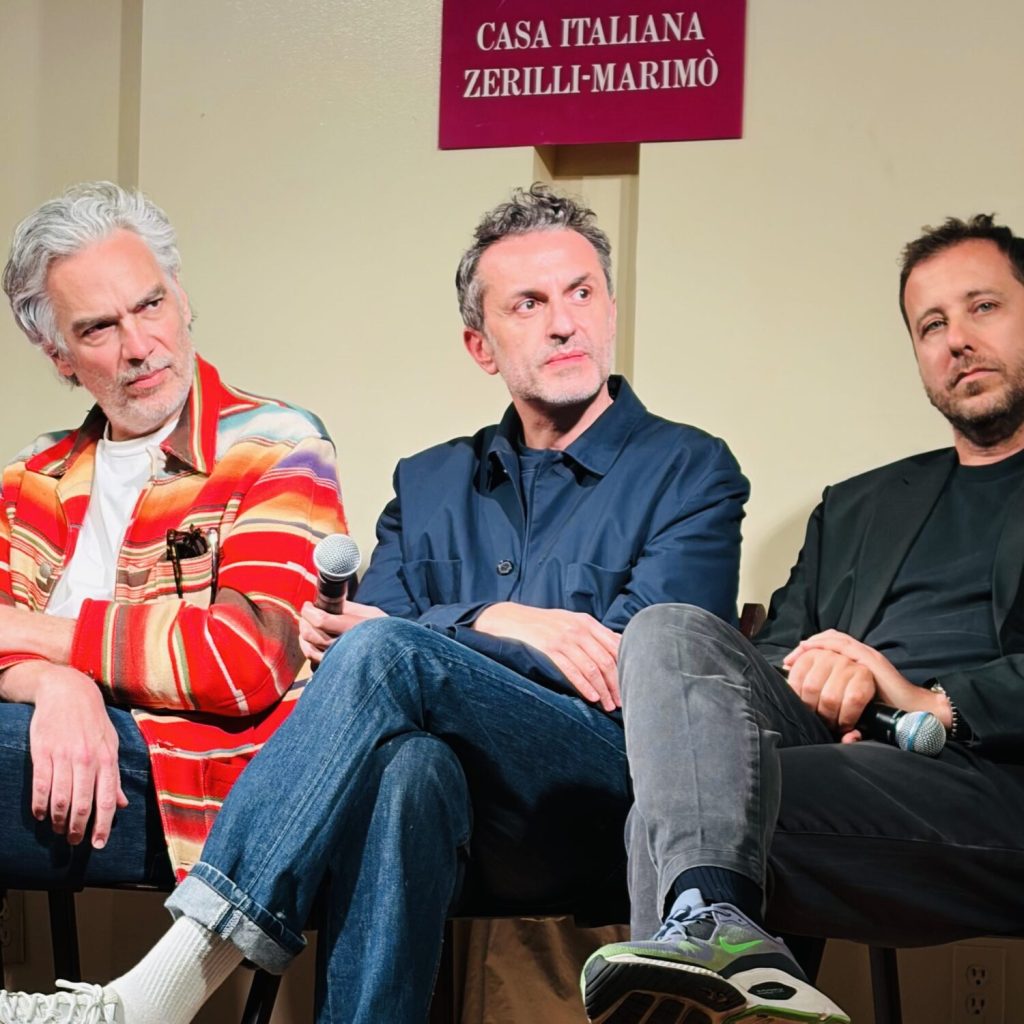
With a round table that brought together directors, producers and interpreters among the protagonists of the new Italian cinema, the Casa Italiana Zerilli-Marimò of NYU closed its cultural season yesterday, confirming a tradition now consolidated in the calendar of Open Roads: New Italian Cinema, the main festival dedicated to Italian cinema in North America.
The meeting, organized in collaboration with Cinecittà, the Italian Ministry of Culture and Film at Lincoln Center, took place on the eve of the 25th edition of the festival, scheduled at the Lincoln Center from 28 May to 4 June. Massimiliano Camaiti, director of the documentary Agnus Dei, Carolina Cavalli (The Rapture of Arabella), Andrea De Sica (The eyes of others), Nicolangelo Gelormini (The joy), Andrea Di Stefano (The master), Gianluca Matarrese (The quiet living) and actress Barbara Ronchi, protagonist of Elisa. The discussion also included the producer of Agnus Dei Giovanna Nicolai and moderators Stefano Albertini, director of the Casa Italiana Zerilli-Marimò, and Leonardo Campaner, PhD in Italian Studies at NYU.
“As tradition, the round table with the directors and artists of Open Roads concludes the season of the Casa Italiana Zerilli-Marimò”, explained Albertini. “It is always a beautiful occasion to talk about cinema but also to talk about Italy through the looks of artists”.
According to the director of the Italian House, the value of the meeting also lies in the possibility, not so frequent, for the authors themselves to confront each other. “We often find that it is the first time they have the opportunity to discuss together these issues, to tell each other and to compare their experiences. Everyone lives immersed in their work, between productions, promotion and new projects. For this reason we see that they appreciate this opportunity of mutual dialogue”.
As it happens every year, the conversation has also been guided by the themes that emerged in selected films. Among the common lines identified by is the relationship with the black chronicle. “At least three of the films presented take the cue from factual events, often even very upsetting episodes. Of course, it is not just reconstructions, but reflections that use those facts to tell society and complex personal stories”.
Another recurring issue concerns unconventional affective relations. “In two films we find at the center a relationship between an adult and a child who are not bound by any bond of kinship but who end up choosing each other”, Albertini noted referring to the abduction of Arabella and The Master. “They are forms of motherhood and elective paternity that show how to choose who to consider a mother, a father or a child even in the absence of biological ties”.
Among the films that aroused greater interest during the debate was Agnus Dei di Massimiliano Camaiti, a documentary that tells the work of Benedictine nuns engaged in the breeding of lambs from which wool are made the poles for the Pope and the archbishops. «It is a little known story and in some surprising aspects». “Through this story the film manages above all to tell the world of the nuns, their relationship with time, with history and with a dimension of existence that today appears almost hidden”.
Upon its twenty-fifth anniversary, Open Roads continues to represent one of the main international windows on Italian cinema, maintaining that balance between emerging authors and established directors, between independent cinemas and more popular productions, which over the years made a reference appointment for the North American public.
The article <i>Open Roads</i>, Italian cinema tells Italy today in New York proviene da IlNewyorkese.