
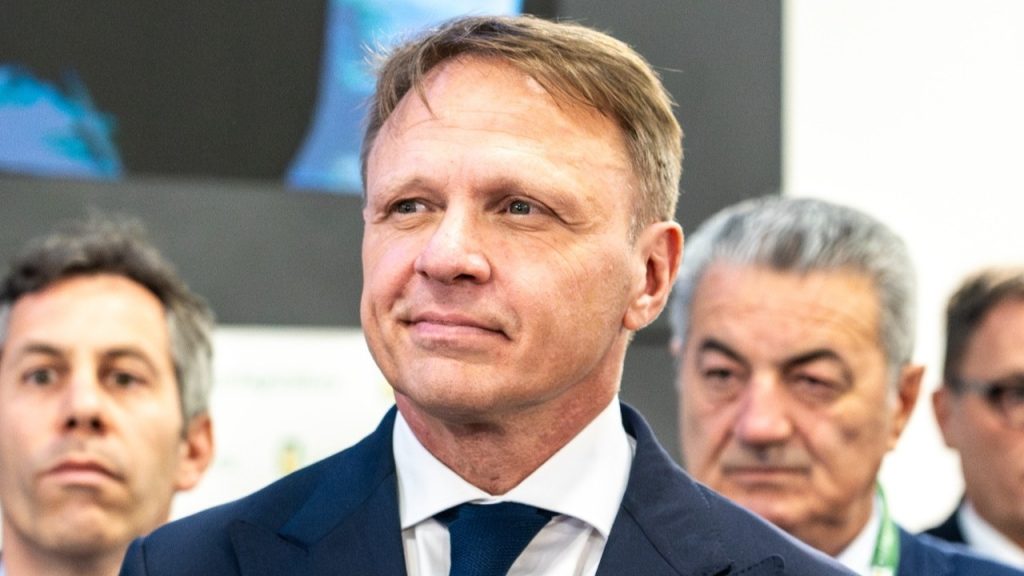
With over 16 billion euros mobilized for the primary sector and agri-food export that has touched the historical record of 72.5 billion, Italy consolidates itself as a global superpower of food. In this exclusive interview, Minister Lollobrigida analyses the concrete results of a precise political choice: to put agriculture and food sovereignty at the centre of national interest. From the rigidity of digital controls to the fight against imitations in key markets such as the United States, to the recent UNESCO recognition, here is the strategy of the dicastery to transform Italian cultural identity into a global economic and competitive advantage.
Minister, the Government has invested more than EUR 16 billion in the primary sector through the Ministry of Agriculture. What concrete results are already seeing Italian companies and producers, especially on international markets?
We have made a precise political choice: to put agriculture, fisheries and agri-food in the centre of national interest. In the three-year period 2023-2025 the Ministry that guide pro tempore has mobilized 16,8 billion euros, with an estimated impact of approximately 87 billion direct added value on the agri-food sector and about 246 billion on the system-country. It means that these investments produce growth, work and greater competitiveness.
The results are already seen today. In 2025 the Italian agri-food exports reached a historical record of 72,5 billion euros, almost double compared to 2015. Italy is today a true agri-food power: it conquers 10.8% of the global podiums of the export of the sector, although it represents just 0.7% of the world population and 0.06% of the planet’s surface. This means that the world seeks Italy, recognizes its quality and rewards its model. And with the recognition of Italian cuisine in Unesco heritage our products will be able to count on a reputational heritage and export will benefit.
The United States is one of the main trade outlets for agri-food Made in Italy. What is still missing to consolidate the presence of our excellences in a very competitive market?
The United States goes beyond what they normally represent other business partners because they are also a place of memory, identity and deep bond with Italy. For millions of Italian-Americans, buying and consuming our products is also a way to express their sense of belonging. And that’s why we have to take a step further: it’s not enough to sell more, we have to get to the United States more authentic Italy.
The numbers tell us that the American market is strategic, in fact, in 2024 the United States weighed 11.5% of the Italian agri-food export, with a growth of sales of 17.4%. According to the main findings, the value flows 8 billion euros and the USA remain the first extra-market EU for our agri-food.
What’s still missing? An even harder fight against Italian sounding, more tools to recognize the original, more coordinated promotion, more ability to accompany Italian companies in a huge and crowded market, in which we can win only when imitations are exposed for what they are.
She has repeatedly stressed that Made in Italy is not only a geographical indication, but a model based on quality, safety, sustainability and just remuneration of work. How do you translate this vision into the action of your dicastery?
Made in Italy is a way to produce and a way to stay in the world. It is the idea that quality is not achieved by compressing the work or lowering the standards, but by doing exactly the opposite: enhancing those who produce well, protecting the territories, ensuring food safety and promoting transparent chains.
This vision translates into concrete measures: support for internationalization, investments on the supply chains, contrast to counterfeit, greater transparency on the label, quality discipline also in Italian catering abroad, promotion of PDO, PGI and biological, strengthening of controls.
There is one point I consider decisive: Italy must not pursue models of others. You have to defend your own. Because our competitive advantage stems from that unique synthesis between quality, identity, biodiversity, culture and work well done that the rest of the world recognizes us.
The recent law to protect Made in Italy aims to counterfeit imitation and counterfeiting. The tricolor strips of the state were introduced on wine bottles. What impact did these measures have?
The inclusion of the tricolor flag and the logo of the Republic on the strips of DOC and DOCG wines as well as being an immediately recognizable sign of Italy, is also of the values of authenticity, quality and transparency. Thanks also to the QR code technology developed with the State’s Polygraphic and Mint Institute, with a simple smartphone you can verify origin, authenticity and excellence of the product. This results in a more solid traceability and an immediate recognisability of the true Made in Italy. This intervention is part of a broader regulatory framework, defined by the law on Made in Italy and the law on Agribusiness Protection. The Cabin of Regia, which has strengthened coordination between the different inspecting authorities, has been permanently rendered. The result is an increasingly structured control system: more than 315.000 annual checks, increasing by more than 25% compared to 2021, with an effectiveness greater than 50%, thanks to an increasingly targeted approach based on risk analysis.
Alongside the internal dimension, the external and digital presidium has also been strengthened: more border controls to ensure reciprocity and security, and a more incisive contrast to online counterfeiting through agreements with large platforms such as Alibaba, eBay, Amazon and Rakuten, to intercept and remove fakes directly in marketplaces.
The goal is to make the system more preventive than responsive, reduce the operating space of counterfeiting and increase the immediate recognition of authenticity, even in global digital channels.
Geopolitical tensions and new international trade policies are affecting global trade. What are the risks to Italian food?
The first risk is that to pay the price of international tensions are the companies that produce quality. Although US market pushovers are in the order of 4.5%, if duties, barriers, instability and unfair competition prevail, to be hit can be a productive model that has built its success on value and not on cost compression.
This is why we insist on two lines: on the one hand, a strong defence of Italian and European interests in trade negotiations, on the other, a strategy of diversification of markets. It must be present wherever there is demand for quality.
In these years the government has worked to open new markets and promote international trade agreements. What are the new opportunities for Italian companies in emerging markets, from India to Latin America, even in the light of Mercosur agreements?
The opportunities are there, and they are great. But I always say that the opening of markets cannot be transformed into indiscriminate opening. We want more export, no less rules. We want new outlets for Italian companies, but under conditions of reciprocity.
In the strategies of the Government it is explicitly indicated the objective of facilitating, together with the Ministry of Foreign Affairs, the entry of Italian companies and products in the global markets, with the goal of 100 billion agro-food exports by 2030. Funds for internationalisation and a strong investment in trade fairs and international promotion are accompanied by this.
Markets such as India and Latin America can represent a great opportunity, but on a pact: that no one asks Italy to give up the quality, safety and dignity of their own production model to enter into a commercial agreement. The rules of our farmers must also apply to those who want to export to Europe.
She has often stated that the role of the government is to support entrepreneurs, not to replace them. What are the demands that come most frequently from companies?
Businesses ask above all one thing: to be put in the conditions of working well and to compete with equal weapons. They demand less bureaucracy, faster times, access to credit, more efficient infrastructure, support for internationalisation and defence against unfair competition.
We are taking concrete action on this. I think of the strengthening of AGEA as a strategic public infrastructure, with more than 10 billion euros in total distributed to the agricultural sector in 2025, more than 5.7 billion provided directly by AGEA, use greater than 99% of rural development resources, and a strong contrast to fraud with over 73 million euros recovered.
The task of the State is not to do business instead of the entrepreneur. It is to remove obstacles, bring resources in time and defend the national value. That’s what we’re doing.
In an international context characterized by geopolitical tensions, what are the main challenges that Italian agribusiness will face in the coming years to preserve its leadership?
The first challenge is to defend our identity without closing ourselves in the world. The second is to innovate without distorting us. The third is to continue to be recognizable in a global market where too many try to appropriate Italian prestige without having the requirements.
Italy now starts from a strong position: it is first in the EU for agricultural added value, first by number of certified products, and its cuisine has become the first culinary model in the world recognized by UNESCO as the intangible heritage of humanity on December 10, 2025.
It means that the world recognizes Italy as a civilization of food, quality and beauty. The challenge of the coming years will be to transform this cultural force into more economic presence, more legal protection and more competitive advantage.
Looking at the future, what concrete objective is the Ministry to strengthen the presence of Made in Italy agribusiness in the North American market by the end of the legislature?
We want to grow the presence of authentic Made in Italy in the North American market and reduce the space occupied by imitations.
Today we know that the phenomenon of Italian sounding takes about 100 billion euros to Italy globally. We also know that the United States is one of the places where Italian cuisine has an extraordinary strength: together with China, they represent over 65% of the global consumption of Italian cuisine, and in the USA the link with our gastronomic heritage is also a deep cultural link.
By the end of the legislation we want more Italian companies present, more certified products, more protection tools, more promotion and more recognisability of origin. In summary: we want Italy to grow in North America. For those who love Italy must be able to find the original, not a copy.
L’articolo Minister Lollobrigida: “Export record at 72.5 billion, now we defend the true Made in Italy in the USA” comes from IlNewyorkese.