
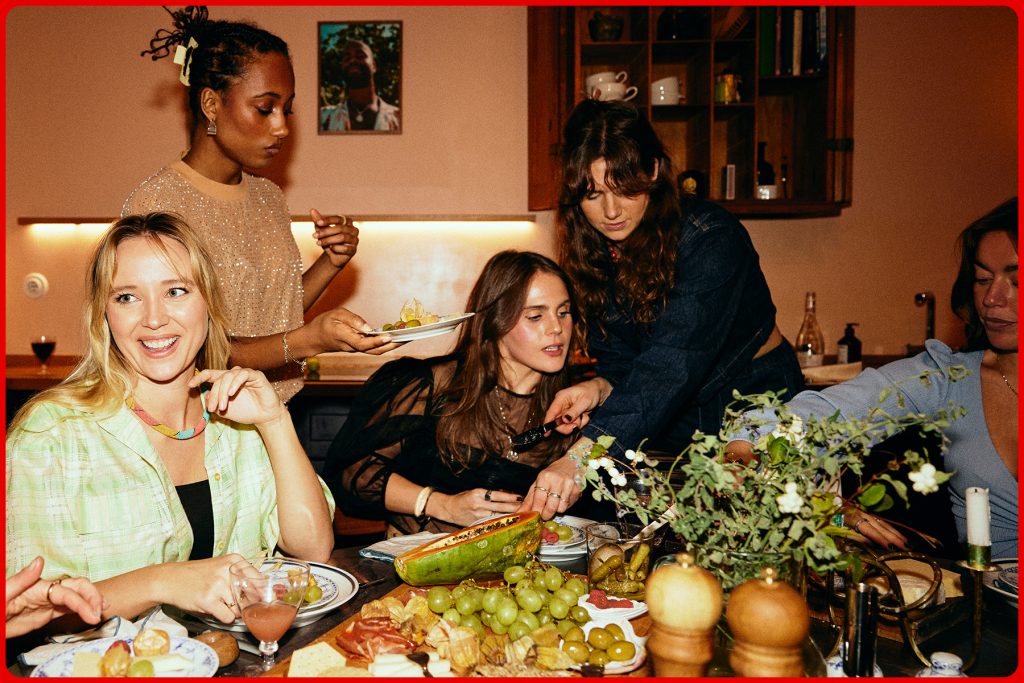
Last weekend, I drank matcha with 20 people who could, according to the AI that selected them, become my new best friends. The experience was arranged entirely by a social platform called 222, which selects a group of strangers to meet up for pre-organized dinners, drinks, yoga classes, rooftop DJ sets, and more activities, all based on converted compatibility insights from a questionnaire. In this case, I was invited to attend a morning matcha ceremony with (to paraphrase the 222 app) at least two people who also “chose The Lord of the Rings: The Fellowship of the Ring as a favorite movie.”
We all met at Samadhi, a wellness space in Greenpoint, Brooklyn, by 10:55 a.m., per 222’s prompt reminders, which — as it stressed through multiple push notifications — I could disregard at the risk of being banned from the app altogether should I choose to cancel, or in the words of the app, “bail.”
“Do you remember that app that would charge you for not going to a workout class?” a woman, also in her 30s, asked me as we quietly shuffled in; “It kind of reminds me of that.” Another woman mentioned that she had been to almost 10 events via 222, from dinners to group exercise. When asked about what drew her interest to the educational matcha ceremony, and to 222 in general, she told me that she had an interest in spirituality, and found it difficult to meet new people as a local who doesn’t just want to bar-hop. This, she explained, felt more intentional. Another man told me he had been to around 40 of the app’s events; this made me feel both at ease, because I assumed they could tell I was new to the experience, and surprised. For whatever reason, I came into the event thinking this would be most folks’ second or third time dabbling in the app. Even though I’d been hearing more and more about 222, I didn’t realize that for some people, it’s become a main character in their social lives.
The idea for 222 was born at a dinner party, and formally launched in 2021. As co-founder Keyan Kazemian tells me, he and co-founders Arman Roshannai and Danial Hashemi would host backyard pasta dinners for friends (and folks they thought could become friends), and encourage them to fill out “custom question cards” and “curate an environment where they could form long-lasting relationships.” The address of the house also started with the numbers 222. There is an air of sophistication in the app’s design: The color palette is mostly deep greens and creams, with a logo that looks like a swirl of whipped cream — cool-coded, ’70s-inspired graphic design. It doesn’t give “I’m swiping through the pile” energy; it gives, “I’m filling out the Big City census.”
While it’s been on the market for over four years, it seems to be picking up steam. I found out about the app through word of mouth, because my own partner, a bartender at a restaurant in Williamsburg, Brooklyn, has been telling me about the uptick in 222 dinners at their restaurant, a number that has doubled from about three reservations per week to six or so in the past year. As Kazemian explains to me by email, “In the past year we’ve gone from three cities to over thirteen.” Now, 222 is in NYC, LA, D.C., SF, Chicago, London, Toronto, Orange County, Boston, Austin, Seattle, Miami, Montreal, and Houston.
Friend-making apps are nothing new to the business of being online (see: Timeleft and Eat With, both in the strangers-go-to-dinner app category). 222 seems to be picking up more steam, however, than Bumble BFF or the “friends only” function on dating apps because it helps folks gather around a wealth of predetermined-ish experiences, with the added pressure-reliever of group-size numbers. As my partner once told me about the time they tried Bumble BFF, “there’s just not enough people on it. You start to see repeat faces. It just felt cringe.” After about an hour at my matcha event, it became very clear that 222 is developing into its own multiverse.
While AI uses users’ self-reported interests and goals to curate the groups who might meet up at each event, the restaurants and cafes that are selected for destinations are often suggested by users, and help feed the company’s proprietary machine learning (ML) model to suggest similar cuisines and experiences. Presently, however, there’s also a human (and business) element to where meetups take place. Kazemian listed a few of the app’s restaurant partners, including Kraam Thai, Askili Orchard, and Twilight Lounge in New York City, and Hatch and Tacolina in Los Angeles, and told me that unlike other platforms, 222 is not selling marketing tools to its restaurants, but simply “delivering them paying customers [who] will like their venues.” Those restaurants, he reiterates, are selected through anonymous qualitative and quantitative aggregated feedback from members. However, as 222 gauges the potential to partner with a space or restaurant, he stresses the importance of finding restaurants that are “intentional about giving their customers an incredible experience, [and] take the 222 partnership seriously.”
It’s interesting to me that, ultimately, the stamp of approval for becoming a 222 stomping ground relies on a far more singular (although, initially aggregated), person-to-person communication process between a 222 staffer and restaurant. “We don’t believe in outsourcing our thinking and creativity to AI,” Kazemian tells me. “Our 20-person team here dislikes the use of AI-generated content and is seriously concerned about the rise of slop online and the bastardization of ‘creativity.’” Instead, he says, “Every part of 222 has a human curation element. Every single question we’ve chosen to ask was hand written, obsessed over, and refined by members of the team.”
Those questions included everything from preferences for food and lifestyle to muddier questions like, “Do I believe humans are born with an innate purpose?” and “Do I enjoy being politically correct?” There were dozens of options for race and religion, with “other” always present as an option. I noticed that the only option for a transgender person was “other,” despite nonbinary, male, and female being offered for self-identification.
As I enlisted for my own 222 experience, I listed Brokeback Mountain as one of my favorite films despite never having seen it, in the hopes of being sat next to fellow queer people instead of Ben Shapiro finance bro spawns; I put that I strongly disliked talking with people who have different political beliefs, even though I think it’s crucial to have open discussions to stop, say, descents into facism (although I’d rather not do so at a matcha ceremony). The app also asked me if I would rather listen to “Taylor Swift, Kanye West, or neither.” (I chose “neither.”) In total, the questionnaire took about 15 minutes, and it left me wondering if I responded honestly (maybe not about having seen Brokeback Mountain) or whether I made tweaks in an attempt to “beat” the survey and find the least obnoxious friend assortment for myself. At every applicable moment, I wrote “Enya” as a response. Occasionally, I wondered what the Victorians would have thought of an app like this.
When I arrived at the matcha class, I was relieved to find that it had a first-day-at-orientation energy that folks could bond over; who can be the odd person out, when no one in the room knows (yet) how to whisk their matcha powder? The room was filled with what seemed like a mostly equal proportion of men and women, and the 10 or so people I talked with were mostly millennials in their late 20s to early 40s, with the sweet spot being early 30s (like myself). There were many fleece vests and North Face puffers, and the majority of folks I spoke with worked in tech, finance, or for a startup; more creative professions included a man who said he worked in fashion, and a woman with a spirituality podcast. One girl was so nervous she was visibly trembling; another talked on end about how she had just gotten out of a relationship; another guy casually brought along his roommate (you can, I learned, request to bring a friend to 222 events in the app) who had lived in Japan and was waxing nostalgic for the culture. All had either a degree of shyness, or, inversely, a tendency to talk over the matcha ceremony instructor who guided us in smaller groups of four as we prepared matcha for one another. As a yapper myself, I figured this proportionate blend of introverts and extroverts was made by AI design, and, for the most part, it created a non-zero (but still, shy) flow of conversation.
The matcha-making itself went over without a hiccup, but the real chat happened after class, when a group of about a dozen or so people autonomously went next door to the neighboring coffee shop, Acre. By chance — or by AI design? — I found the only other two queer women (to my knowledge) in line, and we bonded over the desire to find cool, age-30+ sapphic spaces in the city; one of the women was a 222 first-time attendee, like myself, and the other was not only well-versed in 222 events, but the various messages (and Instagram DMs) they spawn from users. “I can send them to you if you like,” she added, laughing, “but they get pretty crazy.”
After about an hour of talking with the larger group about the snow, and dating, and more snow, and who had podcasts, and who matched (allegedly) with Cara Delevingne on Raya once, I went home. Including the commute, I spent over four hours in the 222 universe that day — although that’s nothing, I was assured by a regular, compared to a 222 superstar user in New Jersey who often “drives in from Jersey for these [222 events], and has been to, like, over 100.”
It would be both easy and fair to tie up this experience with an awkward bow, but it wouldn’t be very interesting. My 222 experience felt a bit clunky, perhaps because my algorithm is still fine-tuning itself. As the app explains, it typically takes five events to find your people, which also sounds fair, albeit expensive (the matcha ceremony costs around $50, although there are options for $20 events).
We can’t escape the uncanny valley effect of algorithmic connections, but I think those of us who roll our eyes at the “cringeness” of friend-making apps are forgetting how, until recently, it was just as cringe to say that you had met your partner online. According to a recent survey, about 42 percent of U.S. adults say that online dating has made the search for a long-term partner easier. Only in this post-COVID-lockdown, post-ironic era, however, do I think we’re finally freeing ourselves from this mentality; if we’ve broken through the cringe mental barriers of Zoom cocktail parties and the pings of isolation, does it really matter how we meet “our” people?
Some folks at my event even said that 222 dinners served as their primary weekly social outings. For me, the most rewarding part of the experience came after the matcha serving, when my ceremony partner earnestly told me that the experience helped him get over some of his performance anxiety. I don’t think I met 20-something — or even half a dozen — new people who I will ever see again, but I did meet people who had one brave, and, for my money, rare trait in common: They showed up. For what, exactly, is a question I’m not sure any of us knew how to answer.