
Seventy-six years ago, on March 9, 1950, Robert Doisneau walked through the streets of Paris with a precise assignment: to tell for the American magazine Life magazine the sentimental life of the French capital in the post-war period. Among the coffee tables and the flow of passers-by in front of the Hôtel de Ville was born Le Baiser de l’Hôtel de Ville, the kiss of two young actors destined to become one of the most iconic images of the twentieth century photography. After decades, the shooting continues to embody Paris of love and returns today to the centre of attention with the great retrospective dedicated to the author at the Genius Museum, which traces the career of one of the masters of European humanist photography.
From 5 March to 19 July 2026 the Museum of the Genius of Rome hosts a large retrospective dedicated to Robert Doisneau, one of the most important photographers of the European twentieth century. The exhibition focuses on an author who, even in the United States, is often associated with a precise idea of “life photography”: that visual tradition that tells daily life with a documentary look, close to the language of the great magazines illustrated in the Second World War, including the American magazine Life, which in 1950 published “Le Baiser de l’Hôtel de Ville”, one of its most famous images and to which it has always been linked its name.
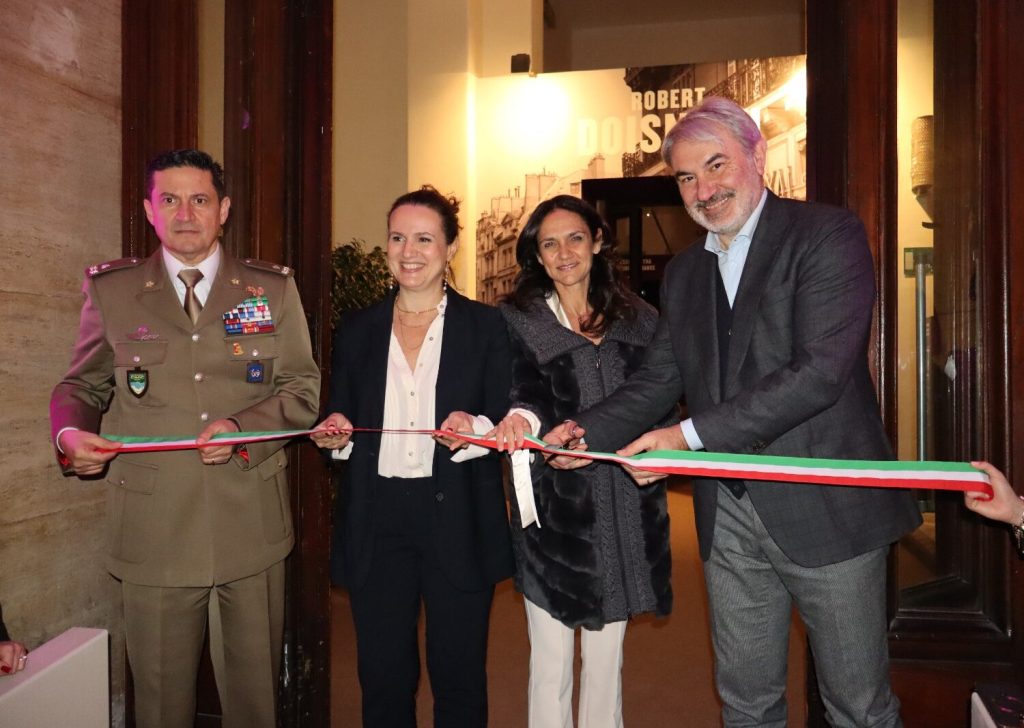
The exhibition, organized by the cultural society Arthemisia and curated by the Atelier Robert Doisneau along with art historian Gabriele Accornero, presents over 140 photographs that cross the entire career of the French photographer. The project is carried out with the patronage of the Embassy of France in Italy, the Lazio Region and the Municipality of Rome, and is also born from a collaboration with the Italian Ministry of Defense and Defence Services, engaged for some years in a program of valorization and openness to the public of the Italian military museums through cultural initiatives and temporary exhibitions. The partners also include the Third Pillar Foundation – International and the General Value Culture program.
Robert Doisneau was born in 1912 in Gentilly, on the southern outskirts of Paris, and during his career he became one of the leading members of the so-called French humanist photography. This photographic thread, developed especially between the 1930s and the 1960s, focused on the daily life of ordinary people: workers, children playing on the street, passers-by, small urban gestures. The black and white Doisneau, often characterized by simple compositions and spontaneous scenes, helped to define the visual imagination of the post-war Paris, alongside the work of photographers like Cartier-Bresson. His images did not seek exceptional events, but ordinary moments able to tell the human dimension of the city.
Among the photographs on the exhibition, as we said above, also “Le Baiser de l’Hôtel de Ville”, the shot made in 1950 in front of the municipality of Paris. The image, today considered one of the most reproduced photographs of the 20th century, was realized during a reportage commissioned by the American magazine Life, who wanted to tell the lovers in the French capital a few years after the end of World War II. Contrary to what was thought for decades, the scene was not spontaneous: Doisneau asked two young actors, Françoise Bornet and Jacques Carteaud, to kiss in front of the goal to recreate a natural gesture in the city’s flow. First published in a reduced format within the reportage, photography became a global icon only in the 1970s, when it began to circulate in posters, postcards and books.
In the 1990s, the shooting was at the centre of a legal dispute over image rights, when several people claimed to be the protagonists of photography. The case helped clarify some legal aspects related to the reproduction of photographic images and the identification of portraits. This story also strengthened the fame of the work, finally transforming the kiss before the Hôtel de Ville into one of the most popular symbols of romantic Paris in the world.
The Roman retrospective is not limited to the most famous images. The exhibition includes street photographs, scenes of life in popular neighborhoods, children playing in the suburbs and less known urban glimpses of the French capital. In addition to these photographs, portraits of central figures from the twentieth century include artists such as Pablo Picasso and Alberto Giacometti, writers and intellectuals such as Jean Cocteau, as well as characters related to cinema and fashion. In all cases Doisneau maintains the same approach: avoid celebratory pose and return subjects in everyday situations.
L’articolo From the Life reportage to the myth: 76 years of Doisneau’s kiss comes from IlNewyorkese.