
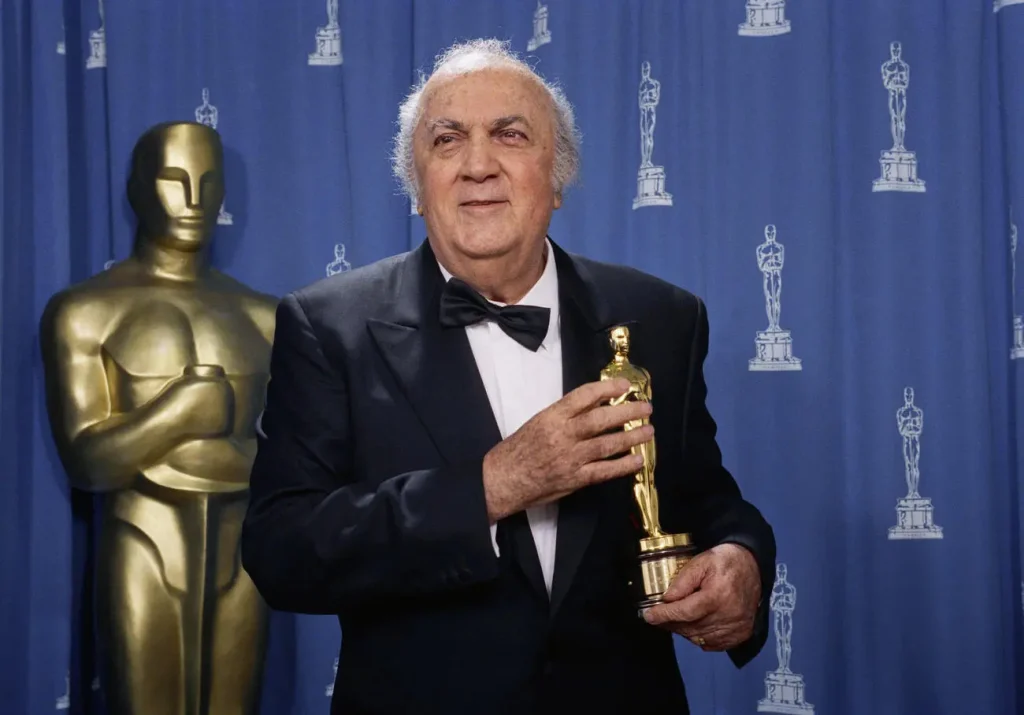
There is a fact that, more than all, tells the deep link between Italy and the Academy Awards: our country is what has won more statuettes for the Best Foreign Film (now Best International Film). Since 1957, when the category has been established, Italian cinema has conquered 11 Oscars, affirming itself as one of the most beloved and celebrated cinematographers in the world.
A primacy that is not only numerical, but cultural. Because behind each statue there is a piece of history, a face, a voice, a vision that has helped to redefine the language of the seventh art.
Before the category of Best Stranger Film was born, Italy had already begun to be noticed in Hollywood.
In 1948 Vittorio De Sica won a special Oscar with Sciuscià. Two years later, in 1950, he replicated with Bicycle Thieves, a universal manifesto of Neorealism. In 1951 it was the turn of Le mura di Malapaga di René Clément, a French-Italian co-production that consolidates the international prestige of our industry.
It is the dawn of an unrepeatable era.
When the category becomes official, Italy transforms it into an artistic domain.
The name that resonates stronger is that of Federico Fellini, able to win four Oscars with La strada (1957), Le notte di Cabiria (1958), 81⁄2 (1964) and Amarcord (1975). Next to Fellini, De Sica again with Yesterday, today, tomorrow (1965) and The Garden of Finzi-Contini (1972), while in 1971 Elio Petri conquered Hollywood with Indagine on a citizen above all suspicion. We continue with Giuseppe Tornatore and Nuovo Cinema Paradiso (1990), a poignant declaration of love on the big screen; Gabriele Salvatores with Mediterranean (1992); Roberto Benigni with La vita è bella (1999); until Paolo Sorrentino who in 2014 wins with La grande bellezza.
In recent years the nominations of It has been the hand of God (2022) and I, Captain (2024) have confirmed the vitality of our cinema but it has not been enough.
Among the most significant pages, it is impossible not to remember Lina Wertmüller, the first woman in history to obtain an Oscar nomination for directing in 1977 with Pasqualino Settebellezze. A milestone that has made era.
In the category Best Director, the only Italian to have won is Bernardo Bertolucci for The Last Emperor in 1988, kolossal who conquered nine statuettes.
On the face of the recitation are the names of Anna Magnani for La rosa tattooata (1955), Sophia Loren for La Ciociara (1962) with the first Oscar assigned to an actress for an interpretation in non-English language and Roberto Benigni for La vita is beautiful (1999), in one of the most exciting ceremonies ever.
Over time, the Academy celebrated with the Honorary Oscar those figures who, with their contribution, shaped the world cinema: Sophia Loren (1991), Federico Fellini (1993), Michelangelo Antonioni (1995), Ennio Morricone (2007), Piero Tosi (2014), Lina Wertmüller (2020).
Recognition, these, which speak of legendary careers, revolutionary languages and an influence that has no boundaries.
But there are not only directors and actors. Italy has also shined in the invisible but fundamental trades of cinema.
Vittorio Storaro won three Oscars for the photography of Apocalypse Now, Reds and The Last Emperor. Milena Canonero conquered four statuettes for Barry Lyndon, Glory Moments, Marie Antoinette and The Grand Budapest Hotel. Carlo Rambaldi gave life to the monsters of King Kong, Alien and E.T. extra-terrestrial. Giorgio Moroder brought the electronics to the Oscars with Midnight Escape, Flashdance and Top Gun. And then Dante Ferretti and Francesca Lo Schiavo, Ennio Morricone (also named for The Hateful Eight), Nicola Piovani, Dario Marianelli, Mauro Fiore and many other excellent artisans who have transformed Italian talent into a global brand.
From the dusty sets of Neorealism to the most ambitious international productions, the Italians at the Oscars wrote a story of talent, vision and creative courage. A story that is not exhausted in a statuette but that lives in every frame illuminated by Storaro, in every note of Morricone, in every face carved by Magnani or Loren.
L’articolo Italy from Oscar proviene da IlNewyorkese.