
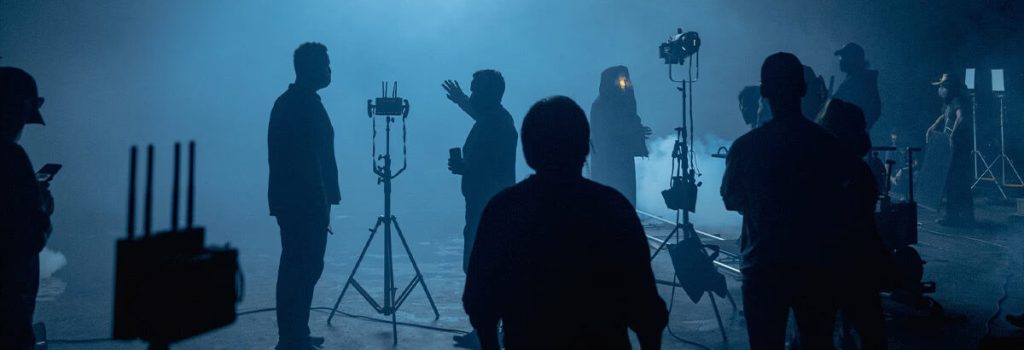
Inspiration, timing and pure instinct. It is the combination of these three elements – more a good dose of luck and courage – which characterizes the figure of the producer, at least as I would interpret it myself. If they told me ten years ago that one day I would take the road to cinema, I would bet they were wrong. And I would have brutally lost. I did not believe, coming from the academic world and from the European design, to be able to dress the shoes of the film producer. On the other hand, it was my job origin that added value to such a complex and interesting figure. When I speak of added value, compared to a background like mine, I refer to the fact that thinking so to say “out of the box”, can only be the best way to innovate the productive role, starting from points of view in some way less common and therefore less explored.
I realized very soon that being a producer in America, especially for an Italian, means entering into an industry that works according to logic radically different from the Italian ones: not only more competitive and more inclined to exceed its own distribution borders, but above all structural. The independent American cinema is founded, in the context of more dynamic economic schemes, on the collection of private investments, which in Italy are not the first reference. Without public support, Italian film production is not sustainable. But for a sportsman and competition lover like me, it is this challenge that makes the challenging role.
The American film market is completely different from the Italian market. Entirely oriented to the results, it is an industry that works, in the sense that it is structured, measurable, able to generate significant economic returns, within which the producer is called to be not only entrepreneur and able to manage the financial strategies, but also cultural mediator at the same time; the latter aspect I deeply love, however keeping particular attention to the productive sustainability that the great Studios seem to have lost sight.
The American market certainly testifies every choice and does so through a meticulous and indiscriminate scrutiny, often cruel. A pressure that forces you to think big. To imagine stories that can speak to a wide audience, without losing authenticity. To find a balance of understanding but transversal identity and replicable in the perspective of an international cinema, constantly growing because required by an increasingly interested audience to look beyond the limits of local politics and to stories that simply fascinate.
For an Italian manufacturer, accustomed to a system more supported by public funds and less oriented to the international box office, it means facing a deep transformation, which requires the learning of a new productive grammar.
It is in comparison with such a demanding system that the producer really becomes author of a vision, a sort of occult director, and leader of a valuable team. And even more in the case of the mission of N41 Studios, a reference for the creation of a cultural bridge between the United States and Italy.
In the case of the Italian-American identity, the first image that emerges is often that romanced by the cinema itself: patriarchal families, restaurants, organized crime, marked accents, folklore. Speakers such as The Godfather or iconic series such as The Sopranos have marked the history of cinema and world television, but have also consolidated a very strong narrative paradigm: the American-italo as a figure related to crime, the closed family, a code of archaic honor.
They are legendary works. It’s not about denying them in any way. In fact. They contributed to make the added value of Italianity iconic in a time when that narrative was adhering to the reality in which it was born: halfway between the Italian disappointment post-second world war and the promise of the American dream. But every great story, when it becomes dominant, is likely to become a stereotype, a unique lens. And when a community is told almost exclusively through one lens, the stereotype ends up becoming identity.
Our history in the United States is much broader and more complex. It is made of women who have worked in textile factories, men who have built bridges and skyscrapers, intellectuals, trade unionists, entrepreneurs, scientists, religious, activists. Each of this is a story of sacrifice, courage, ambition, community, inspiration and social redemption. It’s an immigration story.
Then it is necessary to ask a precise question: what stories have not yet been told? What angles and experiences have remained on the margins? What female figures, such as forgotten protagonists, such as emancipation, solidarity, success and not only can they give back to the cinema the ability to inspire and excite the public, through the magic of the story?
There are so many waiting to be told.
The goal of a producer is to discover and bring them back to light, and in doing so, to restore diversity and new complexity to a community that was fundamental in the construction of modern America.
And I’m not just referring to stories of the past, which would also be reductive. There are also contemporary stories, related to the first and second generations of Italian families emigrated to the United States, which possess the power to enrich the narrative, between past and present. Stories that are not simply representing, but serve to inspire new generations.
To be of inspiration today, and I agree to be very critical, the main objective cannot be the narcisssistic success of the individual or the self-referentiality of an elitist group, but the creation of solid foundations for a collective change in favor of future generations.
Inspiration is not rhetoric. It’s a political act. In a time when identity is often used as a divisive tool, telling stories that show the strength of encounter and cultural contamination is the basis of the proposal of an alternative model.
The Italian-American community was born of a wound: poverty, the need to leave, the separation from the roots. But she grew up and became with the same United States: while New York grew up, as skyscrapers were erect, neighborhoods and businesses were expanding, cultural institutions were founded, so did the Italian-Americans, whose identity was integrated with the American one. They are stories of pain, but above all pride. Of course marginality, but without doubt integration.
Produce cinema in America provides the opportunity to offer these stories to a type of distribution that can really influence narration and spread it into the world.
This means automatically adding concrete value to the Italian-American community, branding it under a new light, to return it a renewed glory in what could be defined as a kind of Renaissance identity. This is the power of cinema, which is not limited only to sterilly representing a reality but is the symbol, it is collective memory, it is projection in the future. Only in this way can a solid and strong Community union be sought. It goes without saying that it is not meant to be reduced to an autocelebrative account, but on the contrary the ambition is to show its internal plurality, thus opening dialogue to other communities.
Besides, I find that in the middle space where an Italian in America lives, there is a potential not exploited enough, because undervalued by useless bell towers that tend to disunite, rather than join forces. But that intermediate space, in which we are all equal, is potentially very fertile. The double belonging certainly allows to understand cultural nuances of both worlds, helping not to betray either of the two contexts; a responsibility that cannot be ignored and that can not be translated only through financial parameters, such as the easy marketing of a product. But it also represents the search for Italian excellence, often already emigrated and integrated into the American social fabric, to valorize and promote them by bringing out their talents in a more structured, cohesive and strongly identity perspective.
There is a colony of Italian emigrants in the United States linked to the cinema industry, which betrayed by the Italian system, sought here realization. By not doing enough network, however, you may lose the potential that such a group possesses. Supporting and promoting their careers, as a producer, is one of N41 Studios’ missions.
Both the Italian-American and Italian community in America will automatically drive for all Americans who love Italy, who often invest or want to invest in our country, as their stories will act as a bridge of narrative connection between the two realities, promoting a new and inspired image of Italy.
Does this seem difficult? Yes, it is. It’s absolutely not for granted. But if we do not follow what is not taken and that seems too difficult, with ambition and the ability to dream, we will never be able to redesign reality, to make it ever better. This means inspiring: collecting the challenge and showing that an alternative is feasible and that everything is possible.
L’articolo Out of the Box proviene da IlNewyorkese.