
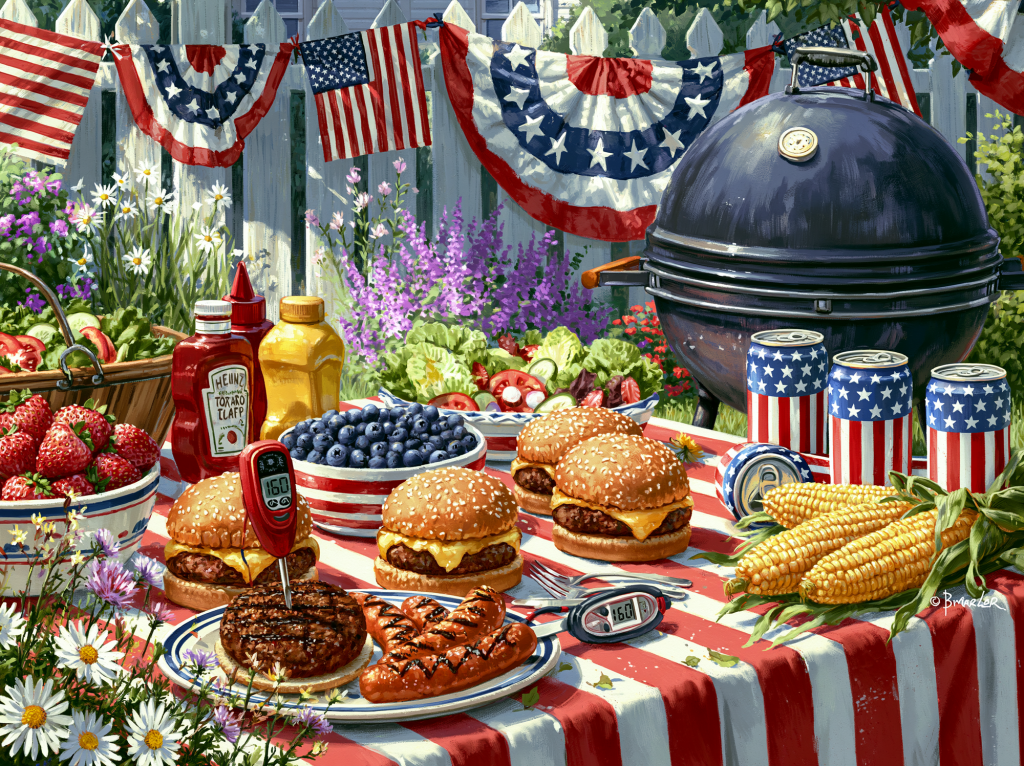
This Saturday, somewhere around 150 million Americans will pick up a hot dog, a hamburger, a scoop of potato salad, or an ear of sweet corn dripping with butter. It is the most democratic meal of the year — the one day a country that agrees on almost nothing sits down to more or less the same plate. On the 250th anniversary of the Declaration of Independence, I want to write something I rarely get to say in this space: the meal we will share this Fourth of July is the safest in the history of the republic. That is worth celebrating.
I have spent more than thirty years on the other side of that sentence. My career has been a long catalog of the days food safety failed — the outbreaks, the hospital rooms, the families who trusted a label and paid for it. Believe me when I tell you that the progress is real, and that it did not happen by accident.
Consider the Fourth of July that the signers themselves would have known. In 1776, nobody at that table understood why food made people sick. Germ theory was nearly a century away. There was no refrigeration beyond a cellar or a block of pond ice, no inspection of any kind, no notion that the invisible could kill you. A summer picnic in the heat was a genuine gamble, and when the gamble went wrong, people called it fate. A child lost to “summer complaint” was mourned and buried, and no one thought to ask which farm, which pump, which cut of meat was to blame — because the questions themselves had not yet been invented.
Then, slowly, they were. Louis Pasteur and Robert Koch gave us the germ theory of disease, and for the first time the enemy had a name. Mechanical refrigeration moved from the meatpacking house into the corner grocery and eventually the American kitchen, and the summer months stopped being a season of dread. In 1906, a young novelist named Upton Sinclair aimed for the country’s heart and hit its stomach instead — The Jungle so sickened the public that Congress passed the Pure Food and Drug Act and the Meat Inspection Act in a single year. Milk, once one of the deadliest things a family could bring home, was tamed by pasteurization, and a generation of children who would have died before their fifth birthday grew up instead.
I will not pretend the modern era begins anywhere but 1993. When four children died and hundreds fell ill after eating undercooked hamburgers, E. coli O157:H7 stopped being an obscure entry in a microbiology text and became a household fear. That outbreak drew the line between the food safety world that came before and the one we live in now. Within a year, the government declared that pathogen an adulterant in ground beef — meaning the burger on your grill this weekend is held to a legal standard that did not exist when I started practicing law. In 2011, the Food Safety Modernization Act rebuilt the system around a radical idea: that the point is to prevent contamination rather than merely mop it up afterward.
Add it up, and the arithmetic is staggering. The hamburger a father flips this Saturday is the safest hamburger any American father has ever grilled. The glass of milk a child drinks is the safest glass of milk in two hundred and fifty years. We have driven Salmonella, Listeria, Campylobacter, and their cousins into retreat — not to zero, never yet to zero, but to a place our ancestors could only have called a miracle.
None of this was inevitable, and none of it was free. It was built by people whose names will never appear in a headline. The inspector walking a plant floor at five in the morning. A company’s director of food safety that pushed for reform. The line worker who pulls a questionable lot because it is the right thing to do. The state lab technician quietly serotyping the day’s stool samples. The FoodNet epidemiologist who notices that three sick children in three different states ate the same brand — and picks up the phone. These are the people who made this holiday safe. They are the reason a hot dog is something no one at your table will think twice about. That thoughtlessness is their monument.
I have made a career of arguing that we can do better, and on most days, I still believe our system is held together with too much good luck and not enough political will. Surveillance can be cut. Inspectors can be furloughed. Lessons can be unlearned. Progress must be tended. But the Fourth of July is not a day for the argument. It is a day for the gratitude that makes the argument worth having.
This Saturday, before the fireworks, I will raise a paper plate to the invisible army that keeps my clients’ ranks from growing. My professional dream has always been a strange one for a lawyer: to make food safe enough that people stop needing me.
On the 250th birthday of a country that keeps, against long odds, getting better at feeding itself — that dream feels a little less far off than it used to. Happy Independence Day. Eat well and eat safely. We have earned both.