
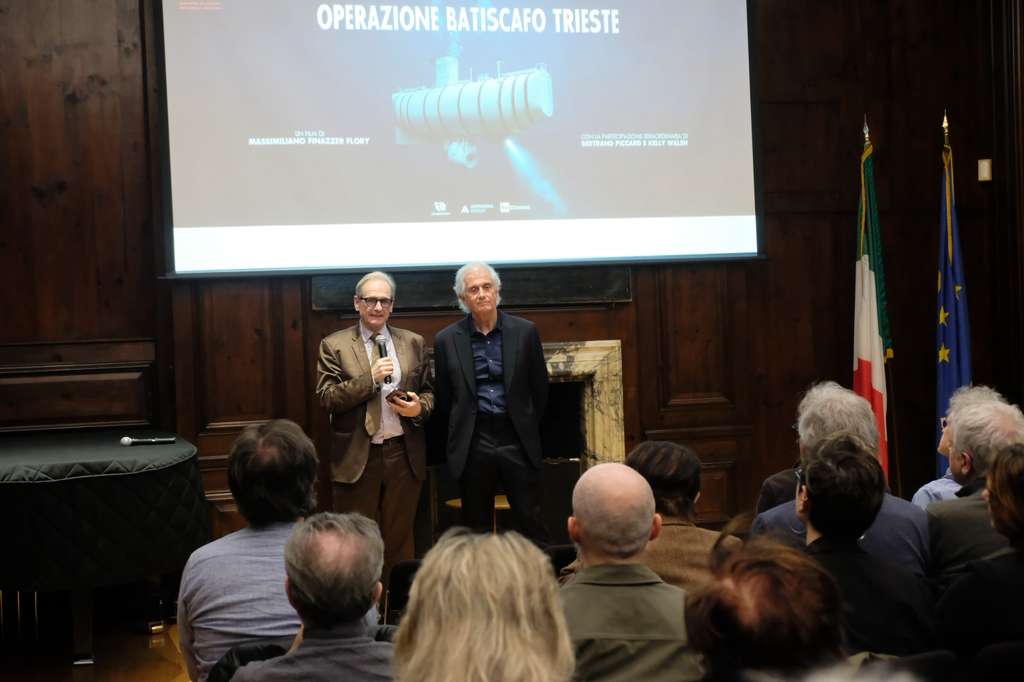
We stayed at the Italian Institute of Culture in New York, where on 30 March last the presentation of the docufilm “Operation Batiscafo Trieste” by Massimiliano Finazzer Flory. Under the guidance of Director Pagliara, the interview with Finazzer Flory revealed the many facets of an enterprise that, over sixty years away, continues to inspire and reflect.
The documentary is not only the chronicle of the faithful reconstruction of the batiscafo that in 1960 reached the record depth of 10,916 meters in the Fossa delle Marianne, but a real tribute to the Italian ingenuity and the pioneering spirit. Finazzer Flory stressed that Trieste, “Switzerland invention and Italian ingenuity”, has represented a “record not only of the world but for the world”, an enterprise that has redefined the limits of human exploration.
From the discussion emerged the unique context in which the project was born: after-war Trieste (1948-1953), a “free territory” in the middle of the Cold War, described as a “laboratory for science and peace”. A time when science was synonymous with cooperation, in sharp contrast to the competition that would characterize the years after 1960. The pioneers, like the Piccards, were celebrated as those who dared to leave their “convenience zone” to imagine and build a new world.
And then the role of the batiscafo in environmental protection: the company of Trieste has contributed decisively to avoid the idea, then widespread among governments, to use the oceanic seabeds as a landfill for nuclear waste, as erroneously believed devoid of forms of aquatic life. The discovery of life to those extreme depths showed instead that the ocean was not a “dead” environment, but a vibrant ecosystem to protect.
But the company of Trieste was certainly not without danger: the descent lasted about 7 hours and 55 minutes and was extremely risky: reached the 8,000 emeters of depth the structure had to be measured in fact with a crack due to the high pressure, which fortunately did not lead to serious consequences. The comparison went immediately to the most recent tragedy of the submarine Titan, and this also tells us how, despite modern technology, the ocean depths continue to be relentless environments.
Besides this, Trieste also ties to America, and this bond was a bit the leading thread of the evening: after the success of the mission, the batfo was acquired by the United States Navy for research purposes and Lieutenant Donald Walsh was the co-pilot of the record immersion. Its conservation at the Naval Museum of the American Navy in Washington, where it is possible to visit it again today, and the media coverage of “Life” magazine, which brought history to millions of Americans, testify to the profound impact that the company had overseas. The same presentation in New York, with an attentive and frequent audience, reiterated the transatlantic resonance of this extraordinary adventure.
Finazzer Flory’s docufilm, with its clever alternation of black and white and color to melt memory and imagination, is not limited to telling the past. It transforms the batfofo from a scientific tool to “design masterpiece” and art exhibited in a museum, a symbol of cooperation between art, science and culture.
L’articolo The Batiscafo Trieste in New York: a journey between history, science and memory proviene da IlNewyorkese.