
Imagine being the parent of an infant and learning that the baby formula in your home may be associated with a life-threatening illness. You rush to the pantry and begin looking for which product codes are associated with a recall notice web site, and you can’t find the codes. Perhaps the container has already been discarded but you know you have used that brand. Perhaps you never even heard about the recall until after the product had been consumed and you’re at the hospital with your sick infant.
In June 2026, Nara Organics recalled all lots of its powdered infant formula after FDA investigated four confirmed cases of infant botulism among infants who had consumed the product. The recall was announced quickly, but issuing a recall and reaching every household that may still possess the product are not the same thing.
That distinction is not theoretical. During a the ByHeart infant formula recall, FDA found recalled product remaining on retail shelves after retailers had already been notified. The FDA, along with state and local partners, conducted over 4,000 checks at retail locations across the country following the recall of infant formula related to an outbreak of infant botulism. During these checks, they discovered that recalled product remained available for sale at over 175 retail locations across 36 states. In one case, recalled product remained available for sale over three weeks after the recall was initiated, and in another case, the recalled product was offered at a discounted price, with the promotional period beginning five days after the recall had been expanded to include all infant formula products from the manufacturer in question. In several cases, recalled product returned by consumers was placed back on shelves. The FDA stated that these preventable situations placed America’s most vulnerable population—infants, for whom infant formula is often a sole source of nutrition—at continued risk of serious illness. FDA issued warning letters in December 2025 to several retailers citing failures to effectuate the recall of adulterated infant formula at their retail locations.
If a recalled product can remain in commerce in retail grocery shelves or available online after a recall begins, it can certainly remain in consumers’ pantries, freezers, vacation homes, and the homes of grandparents or other caregivers.
Prior to this during the Boars Head Listeria outbreak in 2024, there were multiple complaints of recalled food stored in consumers homes and consumed after a recall notice, as evidenced by class actions filed in early August 2024 and a subsequent individual injury lawsuit; in both cases attorneys argued that Boar’s Head’s recall was “designed to reach very few people”. The lawsuits stated that normal everyday consumers did not receive direct text alerts, emails, or clear in-store signage, leading them to consume products already in their refrigerators weeks after the media broadcasted the notice
A recall may have been initiated, publicized, and reported by the industry and government regulators. Yet from the consumer’s perspective and the public health, it has failed if they are not aware and the dangerous product is still consumed after the recall notice.
The measure we are missing
FDA guidance describes recall effectiveness primarily as verification that recall communications reached direct consignees and that those distribution and retail businesses understood and followed the recall instructions. This includes requirements for public warning. The FDA provides specific guidance to assist and provide recommendations to industry and FDA staff regarding the use, content, and circumstances for issuance of public warnings and public notifications for firm-initiated or FDA-requested recalls. These procedures are essential for controlling product within the commercial distribution chain. However, the regulations do not create any legal obligation for newspapers, television stations, radio stations, internet news sites, trade publications, or social media platforms to republish that information. They also don’t routinely measure whether the consumer who ultimately purchased the product had received the communication, or confirmed the actions recommended, or whether it was consumed after the recall announcement.
There does not appear to be a routinely published national measure of the percentage of recalled food successfully removed from consumers’ homes. That absence represents a public-health blind spot. The government and industry measure recall execution far better than recall effectiveness.
The last mile of a food safety recall
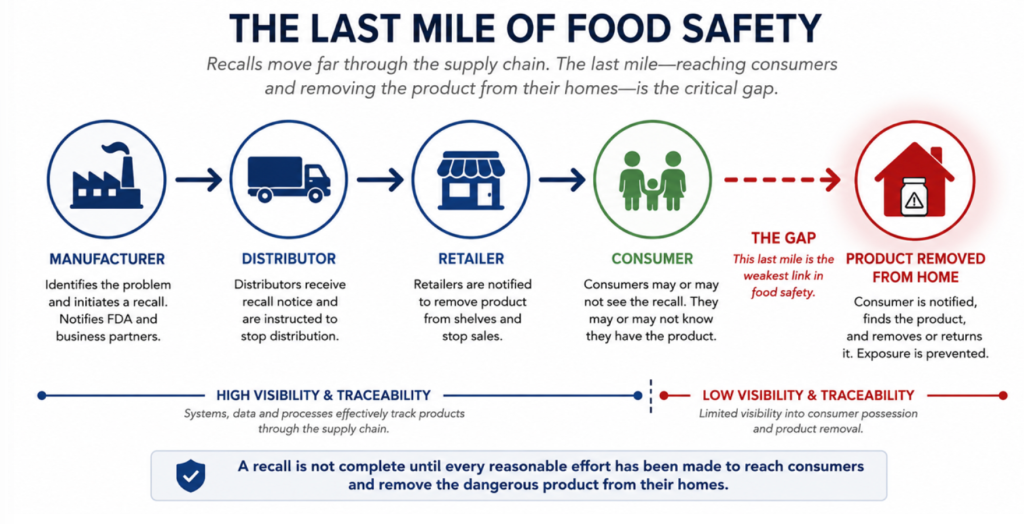
The food industry is investing heavily in the traceability of ingredients from suppliers through manufacturing, distribution, and retail sales and service due to pending FDA requirements. Yet traceability requirements end at the checkout counter or restaurant. The last mile of a food safety recall (Figure 1) is the final, often unmeasured, step between identifying a recalled product in commerce, and alerting a consumer to avoid consumption. Consumer notification and verification of receipt should become a formal component of every recall plan rather than an activity that relies primarily on voluntary media (broadcast and social) coverage or industry and government websites.
The technology already exists
This is not a technology problem. Several grocery brands have publicly described systems that notify customers who may have purchased recalled products using email and register receipt messages. Some have used membership purchase records to send recall notices directly to members whose purchase histories indicate they bought the recalled product. Some also communicate recalls through direct email using online ordering purchase-history information supporting customer communications. However membership requirements often preclude these individual methods from reaching all the likely customers of a recalled product.
The next generation of recall notifications to consumers should include the means for the consumer to quickly confirm if a product in their home has been recalled and/or provide notification of purchase specific product possession in cases where the product packaging is no longer available. For example, if all high risk packaged food products like infant formula had product lot specific QR codes that the consumer could scan themselves, and the QR codes were linked to the product manufacturer’s website that quickly informed the customer not to use the product during a recall (and perhaps included instructions for replacement), consumers could check the safety of a product quickly. To cover gaps when product packaging has been discarded but the consumer knows they have already consumed a product, voluntary digital pantry applications or mobile apps that automatically compare products purchased (e.g., via scanning QR codes) against recall databases via voluntary registration of purchase history for higher-risk products such as infant formula could be additionally helpful. Even a voluntary registration into a national Amber Alert system (e.g., parents or caregivers who purchase infant formula) would be better than the current state of recall communications.
Instead of consumers searching for recall information about a product they have purchased, recall information should search for consumers.
Recall efffectiveness index might encourage government and industry innovation and action
The government should establish a Recall Effectiveness Index (REI) as an industry performance metric. Rather than measuring only how quickly a recall was initiated, the REI would evaluate: (1) identification of affected products and volume of sales at retail; (2) speed of consumer notification; (3) percentage of identifiable purchasers successfully reached; (4) consumer action and product removal; and (5) public-health outcomes, including illnesses occurring after recall initiation. What gets measured gets managed. If recall effectiveness is never measured at the consumer level, the last mile will remain the weakest part of the recall system and continue to lead to illnesses and deaths from previously recalled food products.
Doing the right thing
Food companies possess sophisticated capabilities to communicate with customers before a purchase through advertising, loyalty programs, mobile applications, and digital marketing. Those same capabilities should be used when protecting public health.
If companies can find customers to sell them food, they should make every reasonable effort to find those same customers when a product may place them at risk. That is more than regulatory compliance—it is corporate responsibility.
Food safety does not end when contaminated product leaves the manufacturing facility, nor when a recall press release is issued. It ends only when recalled food is no longer capable of harming consumers.
Companies, retailers, regulators, and technology providers already possess many of the tools needed to close the last mile of a food safety recall. The next step is to make direct consumer notification and verification an expected component of every high-risk recall.
A recall should not be considered successful simply because a press release was issued. It should be considered successful only after every reasonable effort has been made to identify affected consumers, and notify them promptly so they can remove dangerous products from their homes. That is what consumers expect—and it is the right thing to do.