
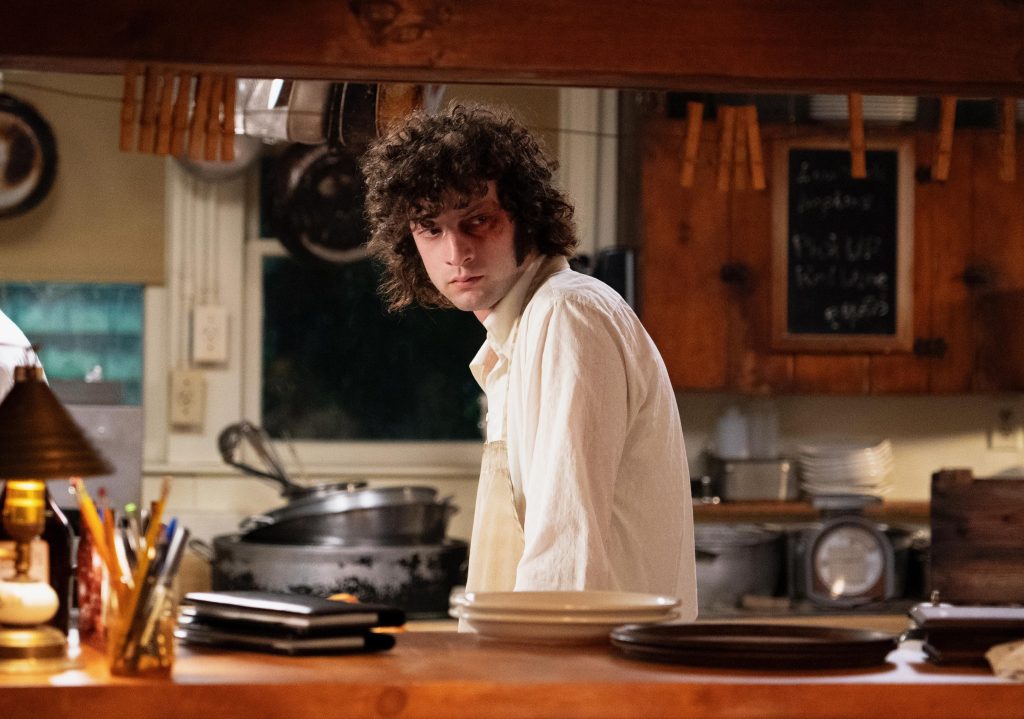
I went into Tony, Matt Johnson’s new Anthony Bourdain biopic, as I imagine many people in the food world did: hesitant and somewhat hoping to hate it, by virtue of my aversion to the way the chef has been mythologized in the eight years since his death. While I think Laurie Woolever, Bourdain’s longtime assistant and author of a 2021 oral biography, is one of the rare people who’s earned the right to tell his story, I’ve found many other attempts to take advantage of the chef’s name and reputation lurid and unnecessary.
And so, Tony: Here is the coming-of-age biopic that promises to show Tony before he became “Bourdain.” It hits theaters on August 7, with expanded national distribution on August 21. Drawing on early chapters of Bourdain’s own groundbreaking book Kitchen Confidential, Tony limits itself to the summer of 1975, when, having failed to secure a writing fellowship as a student at Vassar College, a 19-year-old Tony follows a girl to Provincetown, Massachusetts. Desperate to make it through the summer and with his dreams of becoming a real writer temporarily dashed, he lands at the dish pit of a scuzzy restaurant, where he’s surrounded by foul-mouthed cooks who get a kick out of his missteps. In real life, Bourdain wrote of these kitchen workers — the ex-con, the ex-hippie, the “half-mad” divorcee — as being “like gods” to him, and in the movie, Tony also adopts a tentative admiration of the kitchen’s motley crew, bonding over family meal and following them to parties and drug buys.
Dominic Sessa, the rangy, curly-haired young actor who broke out with 2023’s The Holdovers, plays the movie’s namesake, while Antonio Banderas plays his reluctant mentor, an even-tempered, religiously devout chef who presides over the kitchen with few words but an imposing presence. Close readers of Kitchen Confidential will catch condensing of timelines and of characters in some places, embellishments and extreme dramatizations in others (Banderas’s character, for example, doesn’t map onto any one person in the book). The shared through line is the transformative power of this specific kitchen for the young and impressionable chef. “I was — to be frank — a spoiled, miserable, narcissistic, self-destructive and thoughtless young lout, badly in need of a good ass-kicking,” Bourdain writes in Kitchen Confidential, and this line opens the movie.
What makes Tony compelling, to me, is that it dares to let Bourdain be unlikeable, slowly teasing out our sympathy. In much of the movie, its namesake is insufferable, displaying not the deep-voiced, earned swagger of the worn traveler and experienced cook, but the half-cocked, shaky braggadocio of an insecure boy; it’s Bourdain, we’re reminded, who’s the myth and the legend. The movie renders Tony more of the run-of-the-mill male manipulator type. More sensitive than he’s willing to reveal but too proud to admit to his shortcomings, he gets that ass-kicking and more.
For about Tony’s first third, I, like the girls at those Provincetown parties, found myself more charmed by Sal, the experienced cook who’s played by a sweaty, flirty, and always ready-for-a-fight Leo Woodall. Portrayed as a bad-boy big-brother type, Sal is at least self-aware that he’s a scumbag, while Sessa’s Tony radiates dejected “nice guy” energy, with cloying overconfidence that makes every rejection and punch thrown his way feel justified. Sal’s analog in Kitchen Confidential is Bobby, whose alleyway tryst with a bride still in her wedding gown leads Bourdain to conclude that he wants to be a chef.
There are flickers of interest in food itself in Tony, and recognition of the pleasure found in food. A fish charred over coals at the beach and then drizzled with lemon is revelatory, as are raw oysters; a drunken Tony recalls a time when, as a child in France, he ate them and said they tasted like “the future.” More the case, though, is that we see Tony understand in real time the power of being the person that provides that pleasure, as with Sal or Bobby and the bride. We learn with him how kitchen work can reframe his identity: the way it can allow him to impress a girl; or achieve a sense of control; or be seen, himself, as one of those gods.
When a man has been rendered a god for so long by pop culture, there’s something satisfying about seeing him be humbled in this way instead. In an interview with GQ, director Matt Johnson, best known for his indie docufiction, admitted that neither he nor Sessa had “literally any baggage around this guy” — this guy, of course, being Bourdain. Without the sentimental attachment to Bourdain at the peak of his fame, they set out to unpack his vulnerability and his openness to being influenced. In Tony, we see when Bourdain’s affectations — niche references, tendencies toward esoteric words — land with a thud, both a matter of him not yet having found the right audience but also not understanding his own delivery.
The thing about Tony, for better and for worse, is that it could also have worked as a movie not about Bourdain at all. Call it a cheap comparison, given the time period in which it’s set and the Sessa connection, but at its best moments, Tony feels like The Holdovers, another movie I expected to hate but didn’t. It’s a bittersweet but earnest depiction of wading through the confusing years of finding yourself, and realizing that you can’t go it alone, much as you might find yourself at odds with the people around you and how they perceive you. It’s a story about finding mentorship in unexpected places, and the complicated cycle of hurting and repairing, which we all get better with as we age but which we do so clumsily as teenagers. All of this is universally legible, big-name inspiration or not.
Its clunkiest moments, by comparison, are when Tony tries to remind you that it is, in fact, a Bourdain movie and not just a movie about a random kid picking up a job as a dishwasher. Both names thunk into place during the young chef’s eventual interview at the Culinary Institute of America, a cringe-inducing line of dialogue that feels designed to have normie (as in non-foodie) viewers go, “Ohhh, I get it,” like the Leo pointing meme, when they see the trailer. The trailer, for that matter, does not do the movie justice; it seems unsure of how to appeal to both niche food audiences and the everyman, and therefore lands awkwardly in the middle.
A scene in which Tony’s love interest takes a picture of him in the kitchen feels similarly forced when you’re aware of that one picture of young Bourdain in a Provincetown kitchen. And while Bourdain did write that oysters tasted “somehow… of the future” in Kitchen Confidential, which was published when he was in his 40s, the line feels smarmier than it should in the context of the movie, in which it seems intended to position Bourdain as a child as a kind of savant, when really, I think the movie intends to portray him as having landed in kitchens more as a result of being an opportunist. Despite the distance Johnson and Sessa perceived themselves having from Bourdain at the project’s outset, it’s clear that there’s still some tension between their positioning and what it feels like audiences need in a Bourdain biopic.
The very concept of a Bourdain biopic is kind of like The Bear in the sense that I think many people in the industry will write it off on its premise. I certainly wouldn’t fault anyone who chooses not to engage with posthumous Bourdain culture grabs, since I, too, thought I was one of them. As with The Bear, those aversions feel valid; there’s too much personal history and too many close-to-home feelings. But what I think works the most about Tony is that it’s grounded in the feelings.
It’s less a movie about the myth of Bourdain, and more a movie about the relatable arc of knowing who you want to be but not quite knowing how to get there and raging against that. It could be about any cook, any person; it happens to be a movie about someone we all loved.