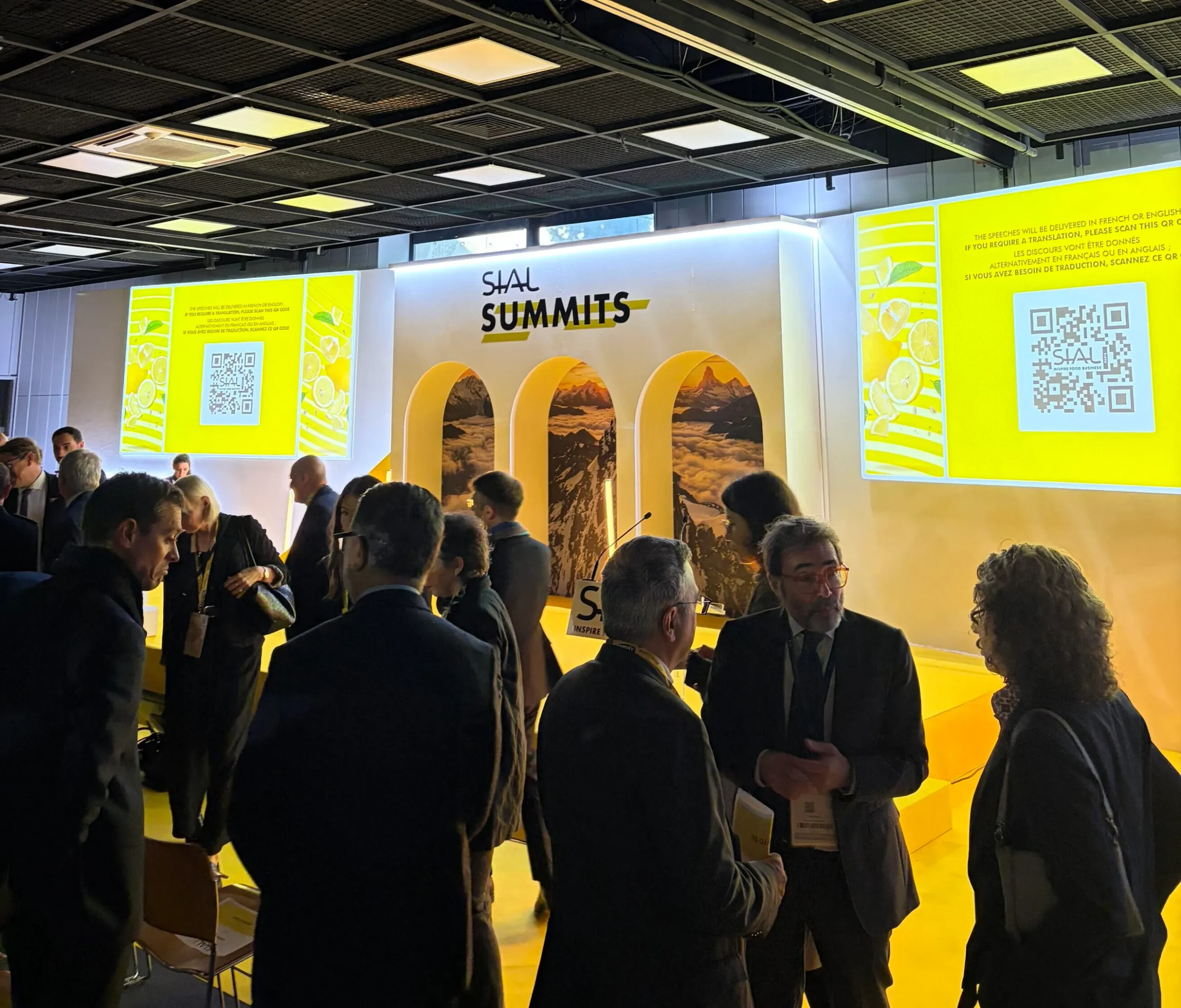
For a small food producer, attending an international trade show means finding the money, staff and expertise to reach buyers far beyond its usual market. At SIAL Paris 2026, collective pavilions and regional delegations helped Italian businesses share that effort, placing smaller producers alongside established brands at one of the world’s largest food industry gatherings.
Around 700 Italian companies exhibited at Paris Nord Villepinte during the five-day event, which ended on Wednesday, October 21. According to the Italian Embassy in Paris, Italy ranked first for exhibition space occupied.
Two substantial collective initiatives supported that presence. ICE, the Italian Trade Agency, organized a pavilion of 218 companies covering approximately 3,000 square meters. Universal Marketing, headed by Donato Cinelli and the Italian representative for the SIAL network, coordinated more than 200 companies, consortia and producer organizations across another area of over 3,000 square meters, involving Sicily, Calabria, Campania, Molise, Lazio, Sardinia and Puglia.
The regional delegations showed how varied Italy’s food industry is. Molise emphasized micro and small businesses, certifications and products including wine, olive oil, cheese and truffles. Calabria brought 39 food and beverage companies, with offerings ranging from ’nduja and baked goods to citrus drinks.
Sardinia focused on Pecorino Romano, Pecorino Sardo and Fiore Sardo. All three hold Protected Designation of Origin status and account for an important part of the island’s dairy production, although producers must also contend with the higher costs associated with their location. Businesses and consortia from Sicily, Lazio and Puglia represented their own regional supply chains.
Campania used pizza as a way to introduce buyers to several industries at once. TuttoPizza International, developed with Comexposium and Universal Marketing, combined demonstrations and tastings with a presentation of the ingredients behind Neapolitan pizza: flour, tomatoes, mozzarella, fiordilatte and olive oil.
Speaking to ilNewyorkese, Comexposium Group CFO Arnaud Boussemart explained that the partnership between TuttoPizza and SIAL connects a product familiar to consumers worldwide with an international commercial network.
Another Campania initiative extended that approach to tourism. The Approdo di Ulisse local action group presented “Nuove rotte per i nuovi mercati,” bringing together food from the Sorrento Peninsula, Amalfi Coast and Capri with the areas’ restaurants and cultural offerings. Wine, olive oil, cheeses and certified products were presented both as goods for importers and as part of the experience of visiting their places of origin.
The potential audience was substantial. Organizers had projected around 8,000 exhibitors and 295,000 trade visitors across 280,000 square meters, while the official directory listed nearly 7,800 exhibitors.
France itself is a major customer. As the Italian Embassy’s figures show, it imported €6.84 billion in Italian food and agricultural products in 2025, up 4.78 percent, making it the sector’s second-largest export destination after Germany. Imports rose another 2.3 percent to €3.35 billion in the first half of 2026. Italy’s worldwide exports in the sector exceeded €72 billion in 2025.
At the show, ICE President Matteo Zoppas discussed tariffs, conflicts, instability and competition from products using Italian names or imagery despite being made elsewhere. He also reiterated the national target of €700 billion in total exports.
Alongside those commercial concerns, SIAL Innovation marked its 30th anniversary with more than 2,750 submissions and 775 selected innovations. Smaller Italian producers were therefore entering a marketplace shaped both by demand for regional specialties and by changes in food products, packaging and consumption.