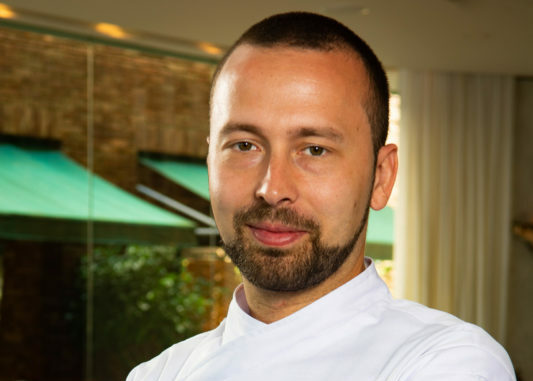
Born in Empoli and raised between Gambassi Terme and the Val d’Elsa, Nicola Fedeli’s relationship with food began long before it became a profession. He grew up in a farming family, where cooking was not a craft to be romanticized but a daily, necessary act. Meals were made to feed workers, not to impress guests: bread baked in wood-fired ovens, large roasts, long Sundays around the table. That environment shaped his understanding of food as something concrete, tied to land, effort, and responsibility.
Choosing culinary school felt like a natural step rather than a calling. Fedeli trained at the Bernardo Buontalenti Institute in Florence and started working in professional kitchens at just fifteen. The real shock came early, inside fine-dining restaurants where discipline was non-negotiable. His first decisive experience was at Osteria del Vicario in Certaldo Alto, followed by work at Il Castello del Nero and Belmond Castello di Casole. Two mentors proved fundamental: Michele Targi, who taught him rigor, technique, and respect for hierarchy; and Daniele Sera, with whom he opened Castello di Casole, who introduced him to refinement, modern organization, and management. From that combination emerged a clear identity: classic Italian cuisine, structured and elegant, without chasing trends.
Before New York, however, there was Brazil. When the Fasano Group offered him the opportunity to move to Rio de Janeiro, Fedeli left everything behind and started over. The experience was far from comfortable. Staffing was unstable, daily operations were unpredictable, and cultural differences were constant. Yet Rio became a turning point. The city’s contradictions—its beauty and its chaos—forced him to adapt, mentally and professionally. Brazil taught him resilience and flexibility, qualities he considers essential to survive later in New York. After three years, the results spoke clearly: the restaurant reached stability, and the Fasano Group entrusted him with an even bigger challenge.
In July 2021, Nicola Fedeli was appointed Executive Chef of Fasano Restaurant New York. Today, he leads one of the most respected Italian fine-dining kitchens in the United States. His approach is deliberately uncompromising. He has never adapted his cuisine to American expectations, nor has he softened flavors to meet market trends. For Fedeli, authenticity is not a slogan but a boundary. His dishes are rooted in Italian tradition, built on discipline, balance, and deep respect for ingredients. He sees himself not as an innovator or interpreter, but as a custodian of tradition.
This philosophy is reflected in the roles he has taken on outside the kitchen. Fedeli is an ALMA Brand Ambassador for the international culinary school founded by Gualtiero Marchesi, a recognition he considers a responsibility rather than a title. He is also an Ambassador of Taste and a member of Euro-Toques Italy, and has participated in institutional initiatives promoting Italian cuisine at venues such as the United Nations and UNESCO. For him, these roles serve a single purpose: protecting Italian gastronomic culture abroad from simplifications and distortions.
The profession, however, has come at a cost. Fedeli speaks openly about sacrifice. From adolescence into adulthood, his life has been structured around long shifts, physical fatigue, and constant pressure. While others built social lives, he worked. New York, in particular, has tested him. He describes it as the most demanding city in the world for human relationships—fast, unforgiving, mentally exhausting. He has seen talented colleagues burn out, give up, or lose themselves under the weight of expectations.
Despite this, Fedeli remains clear about what the job requires. Cooking, he insists, is not performance. It demands discipline, patience, and endurance, but above all a real connection to the craft. He often warns culinary students that this profession is not for everyone. Knowing techniques is not enough; you must cook with your hands, your head, and your memory.
Looking ahead, his ambitions are surprisingly grounded. One dream is to return to his olive grove in Gambassi Terme and finally produce his own olive oil. Another possibility is managing the hotel restaurant of his wife’s family in San Candido. In the meantime, he is working on a new project in New York: producing traditional Italian panettone locally, without compromises. His legacy, he hopes, will be measured not in awards but in influence—helping a new generation rediscover cooking that speaks of home, memory, and substance. Not food designed for social media, but dishes that people remember and return to.
Because, for Nicola Fedeli, taste is memory—and memory is what lasts.