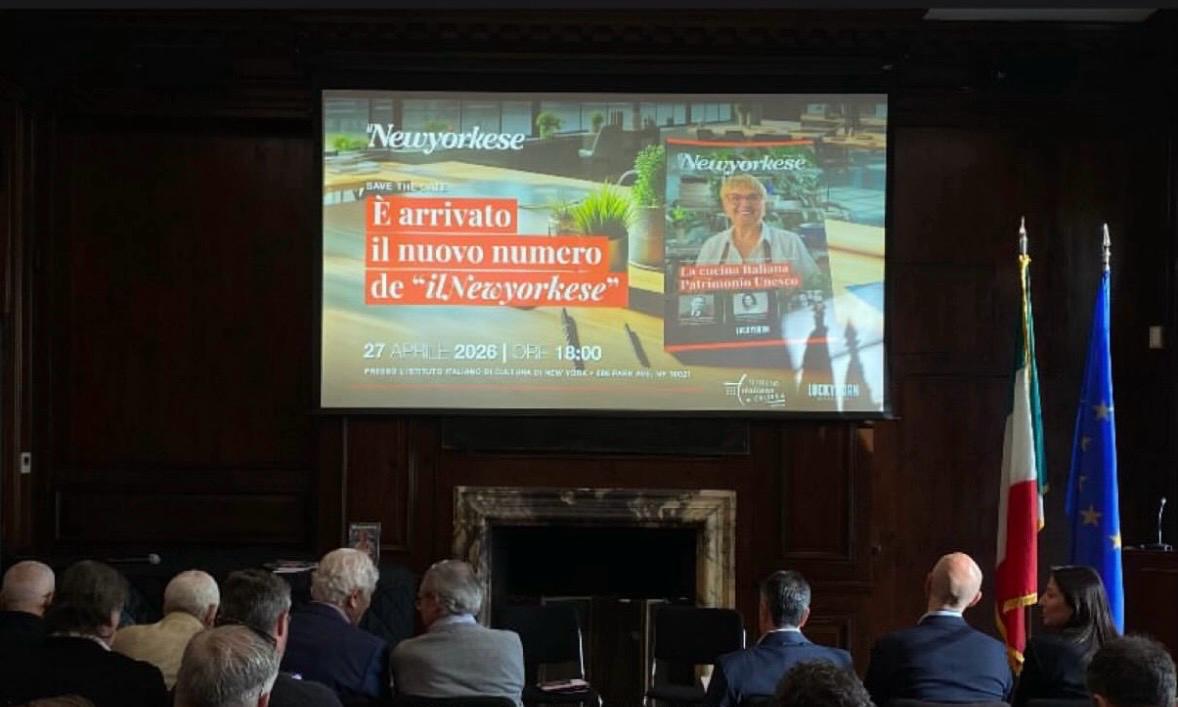
At the Italian Cultural Institute of New York, a new issue of ilNewyorkese was unveiled this week, dedicated to a milestone moment: the recognition of Italian cuisine as part of UNESCO’s cultural heritage.
The event brought together institutional leaders, chefs, entrepreneurs, and voices from across the Italian-American community, all reflecting on what this designation means—not just for Italy, but for its global identity, especially in the United States.
Opening remarks came from Deputy Consul Alessandra Oliva, cultural attaché Silvia Mongardo, and Silvana Mangione. Mangione framed the recognition as “a victory for our chefs,” emphasizing that Italian cuisine today is not frozen in tradition but constantly evolving—particularly across American cities where it continues to adapt and grow.
That evolution is also reflected in the media platform behind the project. Founder Davide Ippolito described ilNewyorkeseas a rapidly expanding editorial network now reaching millions of readers monthly, with editions across major U.S. cities and internationally. The upcoming print launch of Good Morning Italy signals a further push into English-language storytelling for a broader American audience.
The issue itself is the result of collaboration between institutions and industry leaders, with contributions from Italian Agriculture Minister Francesco Lollobrigida and Deputy Prime Minister Matteo Salvini, alongside the support of the Italian Trade Agency.
“We’ve organized numerous initiatives to promote authentic Italian cuisine,” said Erica Di Giovancarlo, pointing to events in New York, Chicago, and the Summer Fancy Food Show. “This recognition finally reflects that effort.”
Beyond institutions, the conversation turned to the lived experience of food in New York. Journalist Marta Galfettidescribed the city as a place where “you can travel without boarding a plane,” recalling how her storytelling project began during the pandemic, exploring neighborhoods through the people who shape them.
But the UNESCO recognition also raises practical challenges. Stefano D’Angelo highlighted the complexity of maintaining authenticity across the supply chain. In the U.S. market, he noted, reliability and logistics are as critical as quality. “If a product doesn’t arrive on time, it loses shelf space,” he said, stressing the need for Italian companies to establish a physical presence in the United States.
For figures like Ernest Lepore, a historic voice from Little Italy, the conversation remains deeply cultural. “Through food, we built a community,” he said, positioning cuisine as a bridge between generations of Italian Americans.
Chef Fabrizio Facchini, who worked closely with institutions on the UNESCO campaign, pointed to the broader social impact of the initiative, including inclusive events such as a Paris dinner involving people with disabilities. He also drew a clear distinction: “There are two cuisines—Italian and Italian American. They’re different, but both tell an Italian story.”
That duality was echoed by chef Tony Grande, who arrived in the U.S. in the 1970s when authentic ingredients were nearly impossible to find. “We had to adapt everything,” he recalled. Today, he sees a new level of awareness and access that allows for greater authenticity.
Entrepreneur Mario Terrana brought a personal perspective, reflecting on the challenges of early immigration and how recognition like this reinforces the value of Made in Italy abroad.
Closing the event was the presentation of Piazza Italia, a project by Marco Giovanelli designed as a hub for Italian companies in New York. Originally launched during the pandemic, it is now expanding into Times Square, aiming to serve as a central platform for business, culture, and community.
In many ways, the evening made one thing clear: Italian cuisine in America is no longer just about nostalgia or tradition. It is infrastructure, identity, business, and diplomacy—recognized now not only by those who live it every day, but by UNESCO itself.