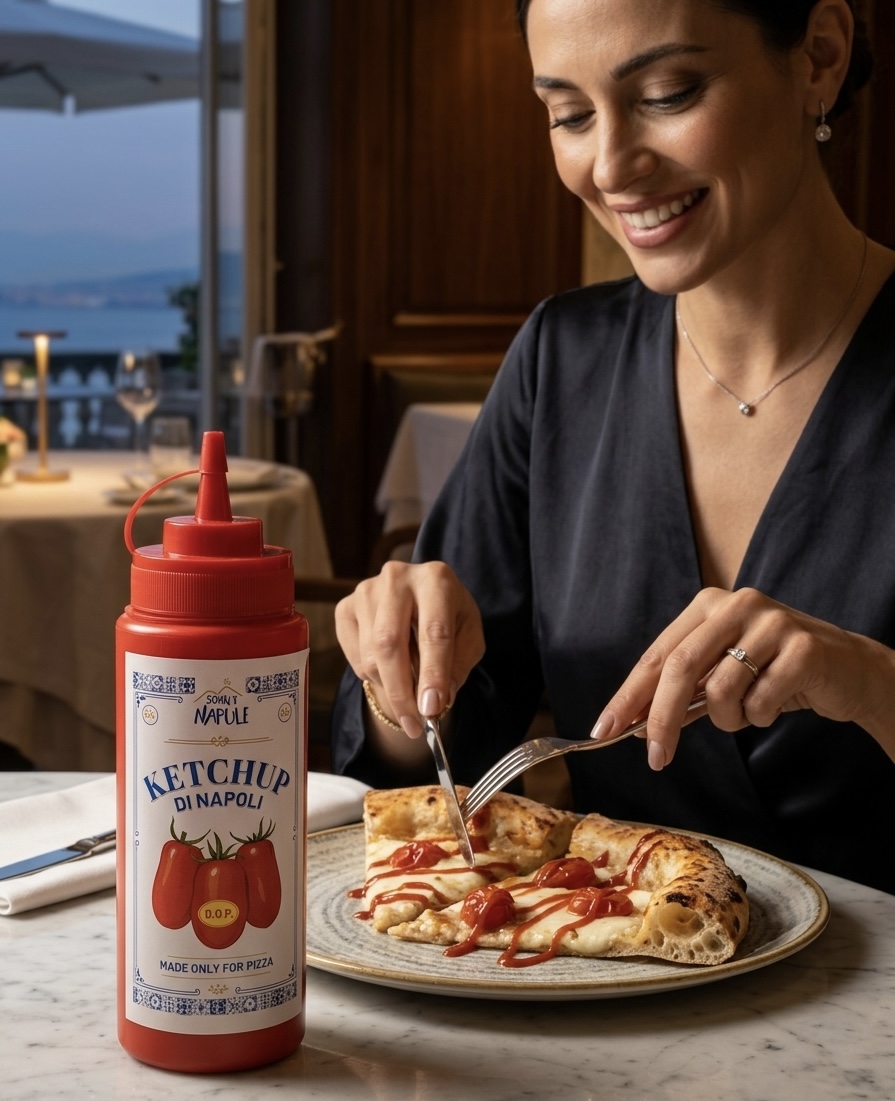
Song e Napul, the beloved Neapolitan landmark on Housto Street, has done the unthinkable: created a ketchup worthy of Italian pizza. We tasted it. We philosophized. We could not stop dipping.
There is a long and complicated history between the Italian palate and the humble bottle of ketchup. In Naples — that volcanic, volcanic city of pizza, of Caravaggio, of controlled chaos and ferocious beauty — the very idea of squirting American tomato sauce over a Margherita would be considered not merely bad taste, but a philosophical crime against civilization. And yet, as with most great innovations in history, the real revolution didn’t come from Rome or from some tasting room in Modena. It came from a kitchen on Eighth Avenue in Manhattan.
Song e Napul, the neighborhood institution that for years has been quietly serving what many consider the finest Neapolitan pizza in all of New York City, has gone and done something extraordinary: they have invented a Neapolitan ketchup. A condiment Made in Italy, designed specifically for pizza, crafted to meet the precise demands of an Italian-trained tongue.
The Problem With Ketchup on Pizza
Let us be honest with ourselves for a moment. The relationship between pizza and ketchup in the American imagination is a fraught one. It is the condiment of boardwalk slices and stadium food, of children who will not eat tomatoes in any other form, of late-night desperation. It is sweet where it should be savory, thick where the sauce should breathe, and entirely too American in its cheerful uniformity.
Italian pizza — the real kind, the kind that emerges from a wood-fired oven at 900 degrees Fahrenheit with a crust that is simultaneously charred, airy, and structurally magnificent — has never needed ketchup. It has San Marzano tomatoes. It has olive oil that costs more per bottle than some people’s lunch. It has a theology of ingredient restraint that makes French cuisine look permissive by comparison.
And yet. There is something deeply human about wanting to dip things. About the desire for a condiment that adds rather than detracts. About the question that Song e Napul dared to ask: what if ketchup, reimagined from first principles with Italian ingredients and Italian philosophy, could actually belong on a pizza?
Napoletanità: A Philosophy, Not Just a Flavor Profile
To understand why this ketchup matters, you need to understand the concept of napoletanità — the almost untranslatable spirit of being Neapolitan. It is not simply a regional identity. It is a cosmology. It encompasses a relationship with food that is simultaneously humble and ferociously proud, improvisational and deeply traditional, open to the world and constitutionally suspicious of it.
The Neapolitans invented the modern pizza. They also invented a way of arguing about pizza that makes constitutional law seem casual. In Naples, debates about the correct thickness of a crust, the precise moisture content of mozzarella di bufala, or the optimal charring of a cornicione are conducted with the urgency of matters of state. This is not hyperbole. This is just Tuesday in the Spanish Quarter.
What Song e Napul has done, in creating this ketchup, is to apply napoletanità to a fundamentally alien object — and transform it. They have taken the American condiment, stripped it of its industrial sweetness and corn-syrup pragmatism, and rebuilt it entirely from Italian raw materials: San Marzano tomatoes grown in the volcanic soil south of Naples, extra-virgin olive oil, a whisper of basil, a balance of acidity that honors the tomato rather than suppresses it.
Napoletanità is not about refusing the world. It is about absorbing it and making it unrecognizably more beautiful.
The Gourmet Argument for Ketchup on Pizza
Here is where we must make a case that will disturb some purists and delight others. The Neapolitan ketchup from Song e Napul is not a compromise. It is not a concession to the American market. It is, in the proper philosophical sense, a gourmet proposition.
Gourmet, after all, does not mean expensive. It does not mean difficult or obscure or available only to those who subscribe to the right newsletters. Gourmet means intentional. It means that every choice in the preparation of a food has been made with full awareness of what came before, what surrounds it, and what the eater deserves. By this definition, a perfectly ripe peach eaten in the right moment is as gourmet as a tasting menu at a three-Michelin-star restaurant.
Song e Napul’s ketchup meets this bar. It is designed specifically to work with the flavor architecture of Neapolitan pizza — not to cover it, not to override it, but to provide a counterpoint of sweetness and acidity that extends the eating experience without betraying the original. Dipped with the cornicione — that magnificent, puffy, lightly charred crust-ring that Neapolitans consider the crown of the pizza — it becomes something the American bottle on the table has never been: an honest accompaniment.
New York as the Place Where These Things Are Possible
There is a final, beautiful irony at work here that only New York City could produce. It is here, in the most aggressively American of American cities, that the conditions existed for a Neapolitan ketchup to be born. Because New York is the city where napoletanità met American ambition, where Italian immigrant hunger for authenticity collided with the relentless, sometimes exhausting, often magnificent pressure to invent something new.
Song e Napul is an expression of that collision. And their ketchup — their Made in Italy, designed-for-pizza, philosophically serious ketchup — is perhaps the most New York thing they have ever done. It is, simultaneously, the most Neapolitan.
The bottle is available at the restaurant. It is red, naturally. It smells, faintly, of basil and of summer somewhere south of Rome. Put it on your pizza cornicione. Put it on nothing else. Some inventions deserve to be treated with respect.